Songs of the Bellflower (Glockenblumengesänge)For Viola und Harp
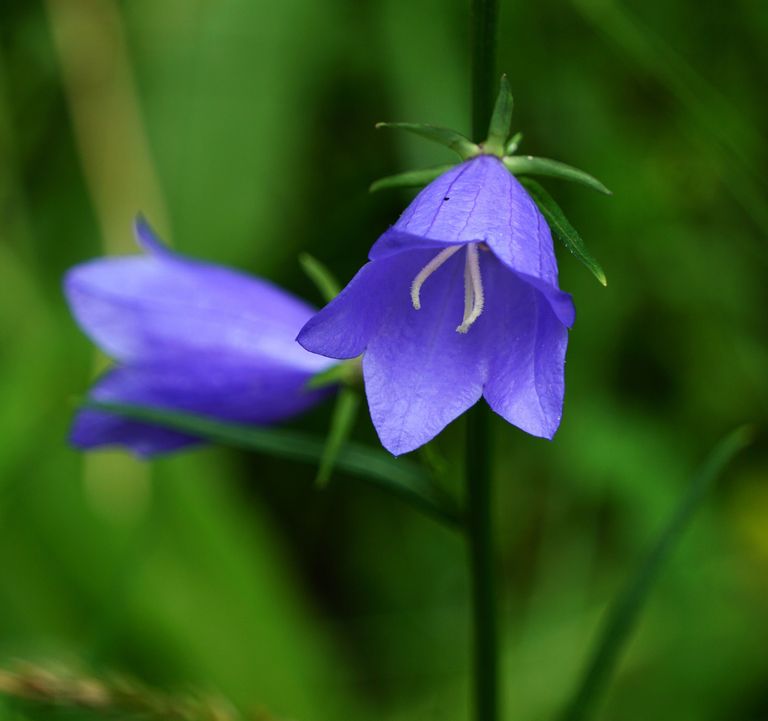
The Glockenblumengesänge are an opulent chamber work for viola and harp. Virtuosic and lyrical passages, resplendent ‘sound-clouds’, hovering and bell-like sonorities alternate throughout.
The chamber-musical, dialogic interplay of the two instruments is interrupted by three solo cadenzas (two for the viola, one for the harp), before both instruments are reunited in the hovering finale. The Glockenblumengesänge possess, as a Gesamtkunstwerk, a … substantive magnitude in all their parts.
The Individual Movements
The first movement is a tribute and homage to nature — to the spirit-infused natura naturans, and to the created world of the natura naturata, manifesting itself in the bellflower as in the new instrument as partes pro toto.
We hear bell motifs and arpeggiated chords in the harp, passages of rapid virtuosity shaped by perpetual changes of metre, distant allusions to jazz, a section largely dominated by the viola as soloist, a plain four-note motif and the theme that grows from it, sumptuously underscored by the harp.
The four-note motif and the theme then permeate the work omnipresently, in countless variations, transformations, and permutations, following the music’s respective poetic intent. The closing phase of the opening movement combines them in chord progressions of a decidedly Romantic cast.
The second movement is a solo cadenza for the harp. A tranquil section anticipates and elaborates a principal motif that acquires great significance in the finale. During these quieter passages, the first stanza of Hartmut Oliver Horst’s poem An die Stille (To Silence) is spoken. A brief, virtuosic, shimmering passage follows the recitation of the second stanza. The final line of the poem — Die Stille träumt, denn sie ist Lied (Silence dreams, for it is song) — is tenderly articulated by short, flowering chords in the harp.
The third movement, An den Abendwind (To the Evening Wind), is grounded in the chant Aer enim volat (For the air flies) by Hildegard von Bingen (see also Sonata for violin solo). The demanding cadenza for the viola, presenting a broad range of virtuosic playing techniques, elaborates motifs from earlier movements whilst pointing forward, once again, to the finale.
The penultimate fourth movement presents itself in a cheerful vein. A further poem by Hartmut Oliver Horst, Glockenblume (Bellflower), is recited in this movement. Playful motifs characterise the first section. In the second, whole-tone progressions give way to semitone sequences at a breathless pace. This is all the more surprising given that chromaticism is, by its very nature, foreign to the harp. Only through careful use of the pedals can an extended passage be realised in purely chromatic terms. Whether this is to be understood in the abstract, or as alpine bellflower caught in a storm, is left for the listener to decide.
The finale, An die Schönheit (To Beauty), is once again an expansive and many-layered movement, its scale forming a counterweight to the opening movement of the Gesänge. The movement is prefaced by a further solo cadenza for the viola, which leads seamlessly into the dialogic sections. From a simple bell motif there grows an opulent, chordal principal theme that — having hitherto lingered in intimation — accompanied us from the second movement onwards. Over broadly spread arpeggios in the harp, the viola sings long, sustained lines. The topos of beauty is here rendered audible and tangible through the musical idiom of the octave, the purest of all intervals. The complete principal theme makes its return as well. Unexpectedly, a passage of strict polyphony emerges — a brief fugato. Here, as throughout the entire work, nature and art encounter one another in the Goethean sense; Hartmut Oliver Horst describes this as a synthesis of ‘spirit-infused nature and ensouled art.’
Ethereal, hovering, and yet virtuosic passages in the harp, which here frequently takes the leading rôle. Then a resumption of the work’s opening. A cyclical rounding is prepared. Once more, octave lines in the viola over harp-clouds of sound. Finally, the viola descends to its lowest note, the low C — a tone of soft, astringent beauty, with the taste of peat.
Address by Manfred Osten
At the première of the Glockenblumengesänge, the distinguished intellectual and Goethe scholar Dr Manfred Osten delivered the introductory address, drawing a connection between Goethe’s philosophical and natural-scientific contemplation of plants — including his relationship to the bellflower — and the composition.
Hartmut Oliver Horst writes of this occasion:
As in a synthesis, the Glockenblumengesänge merge ‘nature and art’ into a harmony that Goethe not only grasped intellectually but also heard in the ‘nature-devout song’ of a natura naturans (in Spinoza’s sense), in that he regarded plants — and the bellflower as an example — in a universal context, as the symbolic interpretation of a ‘Song of Creation’ expressing a metaphysical participation in Being, of a nature that embraces us with love, as Goethe tells us in a poem:
Ich weiß, daß mir nichts angehört
Als der Gedanke, der ungestört
Aus meine Seele will fließen,
Und jeder günstige Augenblick,
Den mich ein liebendes Geschick
Von Grund aus läßt genießen.
This ‘loving fate’ Goethe interprets as the all-embracing love of the natura naturans, which creates the human being and bestows upon him — and upon all Being — everything: his form, his intellectual faculties, his spiritual substance — all of this is the gift of a creation that lovingly calls us into existence, a gift that resounds to us also from this ‘nature-devout song’ of the flowers (‘Gott liebt die Menschen in den Blumen’ — ‘God loves mankind in the flowers’, as Goethe has it), and this harmony, bound into musical inspiration, resounds also in the Glockenblumengesänge, which therein encounter the ‘nature-devout song’ — a song that Goethe heard, and for this very reason he had long since heard the Glockenblumengesänge of the composer Markus Schönewolf in anticipation — as the Goethe scholar and profound connoisseur of the Goethean intellectual world, Manfred Osten, set forth in his address at the première of the Glockenblumengesänge — for was it not Goethe above all who understood and interpreted the creative reality transcending into the infinite — in art as in nature — as something emblematic and parabolic!