I Quattro TemperamentiConcerto for Recorder, String Ensemble and Basso Continuo ad Libitum
Sparkling and virtuosic, lyrical, at times blazing with verve, at others intimate and introspective, brimming with exuberant joie de vivre or steeped in profound melancholy — in a word: baroque. Such is the recorder concerto in its own distinctive musical language.
The Four Temperaments
The title of this four-movement work, I Quattro Temperamenti, alludes to the doctrine of temperaments. This theory is rooted in the ancient doctrine of the four elements and in the theory of the four humours — the so-called humorism — whose development is attributed to Hippocrates.
The doctrine of temperaments classifies human character into four fundamental types, the temperaments themselves. Galen of Pergamon linked this doctrine to the older theory of the four humours, associating each basic character type with bodily fluids — blood, phlegm, black bile and yellow bile — as well as with animals, planets, signs of the zodiac, temperatures, seasons, organs and stages of life.
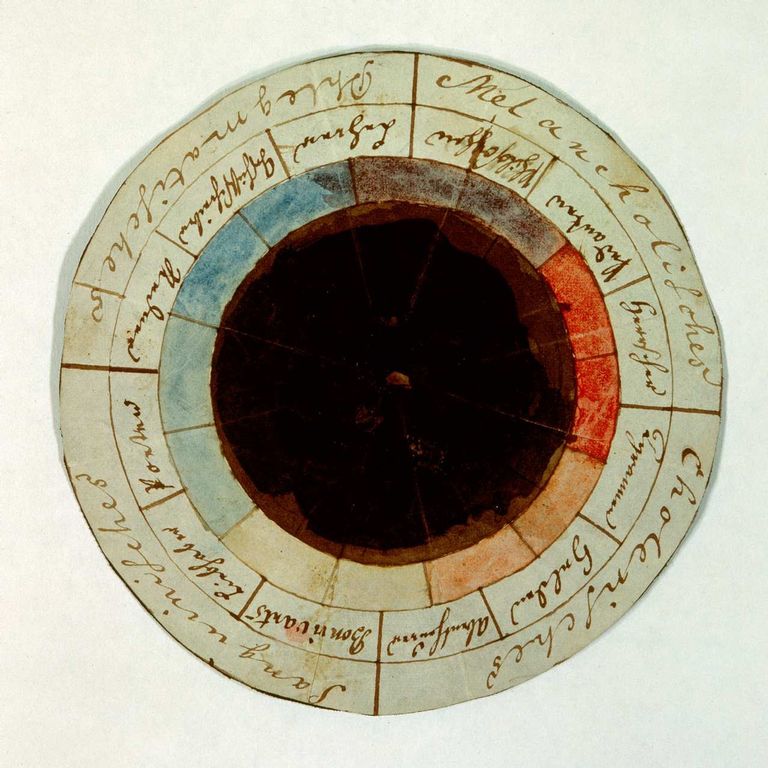
Goethe further assigned colours to the temperaments, and together with his friend Friedrich Schiller preserved the result for posterity in the form of watercoloured drawings.
Johann Wolfgang von Goethe, who was active in many fields of natural inquiry and regarded himself primarily as a scientist — more so than as a poet, and this despite his two volumes of Faust — assigned colours to the various temperaments. Yet rather than placing the four colours side by side in stark succession, Goethe blends adjacent hues, allowing them to flow into one another, forming new tones and nuances, and suggesting that individual character traits and characters themselves are composites of the basic types. And yet certain character traits stand in unmediated, perhaps irreconcilable opposition to one another, not unlike complementary colours. In this respect, Goethe extended the ancient and mediaeval traditions with a new dimension. Together with Friedrich Schiller, he drew and coloured the Temperamentenrose that serves as the frontispiece of the concerto. (That these two so very different temperaments — Goethe’s and Schiller’s — should have found one another, despite Goethe’s considerable initial reserve, is one of the happier accidents of modern cultural history.) The Temperamentenrose came to my attention during an exhibition at the Goethe Museum in Düsseldorf. And so it is that exhibition, and Schiller and Goethe themselves, that provided the occasion and the impetus for this concerto and its intellectual substance.
The Individual Movements
The first movement, Il sanguigno, is exuberant and high-spirited, giving unrestrained expression to a baroque delight in life. Virtuosic, a touch headstrong, and propelled by countless changes of metre, the movement races headlong. The joie de vivre is embodied in a motif — a simple scalar figure that, in its exuberance, repeatedly overshoots its goal by one note in the upward direction.
Following a passage of broadly arpeggiated chords in the ensemble, over which sustained flute lines soar, then a kind of free da capo, the closing phase is introduced by the scalar motif in the ensemble as a whole — the flute falls silent here — before the movement races to its close in headstrong unison.
La malinconia is the title of the second movement. As throughout the concerto, the portrayal of the temperament is abstract, transposed, mediated — not to be understood in any strictly programmatic sense.
A simple neighbour-note motif eventually gathers itself into a scale. As in the opening movement, the scale surpasses its goal; yet what is reached is only the minor, Phrygian ninth, which suffuses the motif with a quality of brooding melancholy.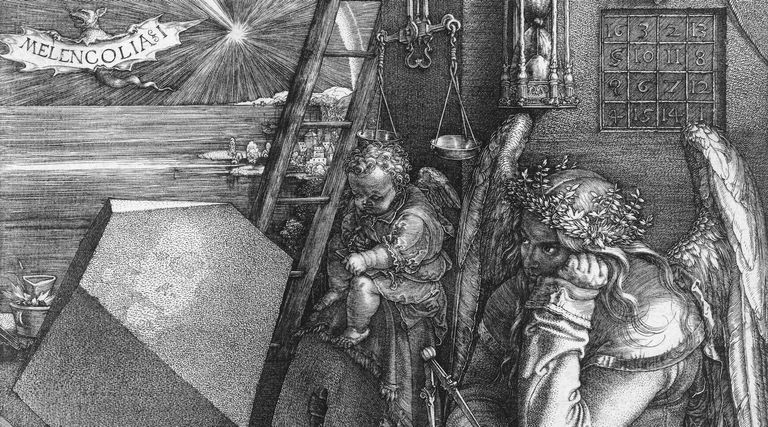
We are well acquainted with Dürer’s interpretation of melancholy — the master engraving of 1514, a date the artist also concealed within the magic square. The expression on the face of Dürer’s allegorical figure is one of vexation, even boredom. Our melancholy, however, is of a different character altogether. As the movement unfolds, it reveals itself as ardent and passionate, erotic, almost languorous. After an initial passage of suffering, the melancholy strives towards a climax, built over a long trajectory. The thematic and motivic material of these passages will be encountered again in the movements that follow.
There follows a sorrowful yet ardent melody in the flute, accompanied for the most part by chords in the ensemble. Then, suddenly, a march-like rhythm pervades the entire ensemble at great dynamic intensity, giving way to an exhaling of flageolet tones.
In the third movement, the ensemble endeavours to rouse the phlegmatic recorder into play. All instruments enter in fugal succession; yet the solo instrument ultimately refuses to follow. The opening of the fugue subject, too, is derived from the scalar motif of the preceding movements. Here the leading note is approached by leap, only to be catapulted upward by a stepwise ascent to a further, unexpectedly placed leading note.
Without warning, the flute interpolates the ‘Muss es sein’ motives from Beethoven’s final string quartet, the F major Op. 135. The remaining instruments accompany with hammering rhythms. As though heeding a reveille and resolving to overcome its own inertia, the flute plays the movement’s expansive principal theme — presented in the flute in diminution whilst the ensemble simultaneously offers a free augmentation. It is worth noting that, at first, only a single transposition of the theme is practicable on the recorder, owing to its rather limited compass: at any other transposition, notes at the extreme low or high end of the range would be missing. This confinement to the one viable transposition, too, carries programmatic meaning — a symbol of the phlegmatic character’s incapacity for development and its constitutional lack of drive.
Then, suddenly, the recorder attempts to begin the theme from the notated D4 (Helmholtz: d’), a semitone lower. The target pitch is the notated C♯5 (Helmholtz C♯’’) — a note that is, in the ordinary course of things, unplayable on the instrument. To produce it, the performer must seal the instrument’s lower opening with the thigh. In the standard standing position, this requires raising one leg whilst bowing the head steeply forward — an attitude that is at once an elegant pose and an image of total collapse.
The finale opens with a cadenza that takes up and combines countless fragments — even the smallest particles — from the preceding movements, not unlike the gradations of colour in Goethe’s Temperamentenrose. The tempo and expressive intensity are ferocious. After a brief moment of calm, a variation cycle begins in the ensemble. The recorder is silent at first, as though in necessary recuperation. The sequence of variations takes the form of a passacaglia — a further tribute to the Baroque era and to the Italy of Vivaldi; yet unlike the practice of that period, this concerto retains not one but three fixed voices.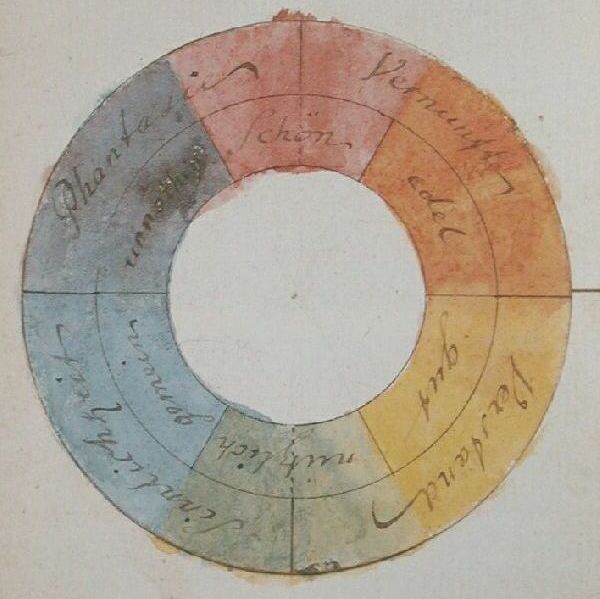
The recorder re-enters only late in the movement. Rather than adopting the serene character of the other instruments, however, it resumes its virtuosic concertising as before — and this apparent detachment from the ensemble is to be understood symbolically.
A great climax builds, with music of almost Romantic colouring. Its goal is the music of the high point from the second movement, though here — and this is what lends this passage its musical and technical complexity — it functions simultaneously as a variation within the uninterrupted, ongoing passacaglia.
The recorder’s furious, virtuosic play gradually subsides, and eventually the instrument concertises with an ardent melody, accompanied by the remaining instruments in homophonic, broken-chord figuration. Everything in this passage seems newly minted; yet the descending motif in the ensemble had already been anticipated by the violoncello at the close of the third movement.
The flute’s gradual assimilation into the character of the group culminates in an elegiac, intimate pas de deux between recorder and solo cello — arguably the most intimate moment in the entire concerto.
Following a silence, the full ensemble enters with bell-like motifs. These, too, seem to emerge from nowhere — they have appeared previously only in fleeting, concealed guises — yet the motif is in fact derived from the final three notes of the third movement’s theme. Into this pealing, the flute plays its pas de deux line, as though in remembrance.
Another sudden break. Then the solo instrument launches into the swiftest passages, as at the opening. Bell motifs are interspersed, mirrored by the ensemble in tremolo. The movement ends, at last, in the unison frenzy of the first.