RapturesConcerto for Violin and Orchestra
An expansive violin concerto dedicated to the sublime state of rapture, of ecstasy — in the Christian sense as much as in the broadly spiritual. The older German term for this state, Verzückung — rendered here as rapture — may be understood as something finer and more subtle than the overwhelming force implied by ecstasy.
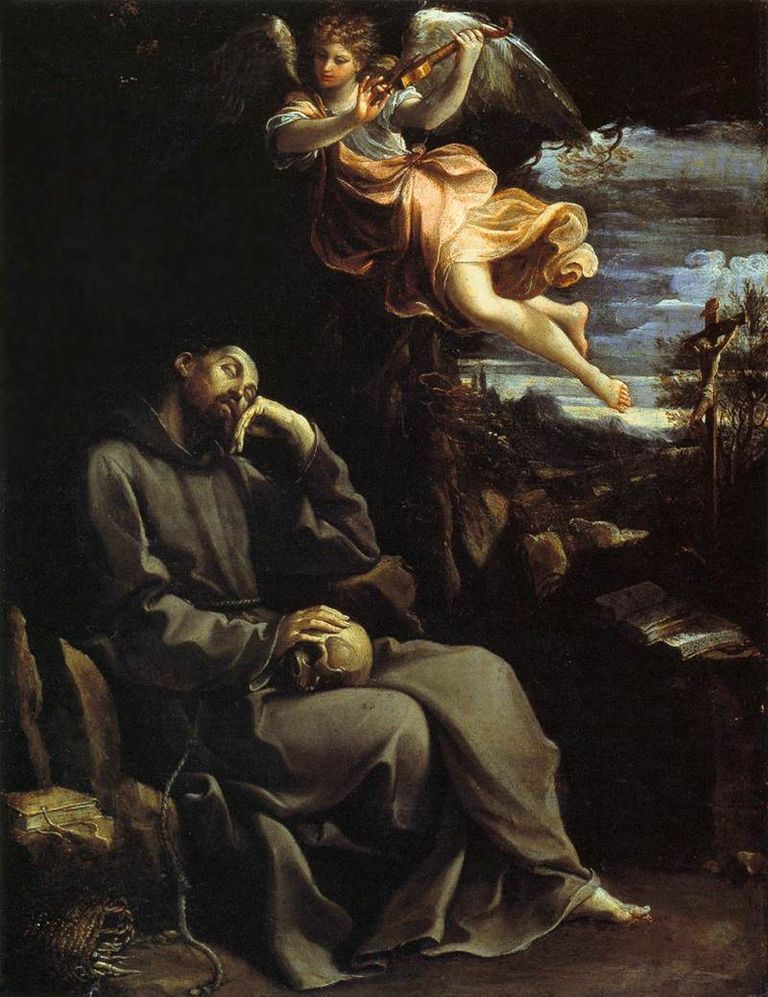
The central figure of the work is Francis of Assisi, that saint whose raptures have been depicted countless times throughout the history of art — one of them frequently showing an angel playing the violin at his side, the very inspiration for the present concerto, which came into being in the eight-hundredth year since the death of Francis.
Each movement of the concerto is accompanied by a painting: the first movement by Guido Reni’s interpretation of that very angel-musician who draws Francis into rapture, as well as two frescoes by Giotto; the second movement by an early Caravaggio.
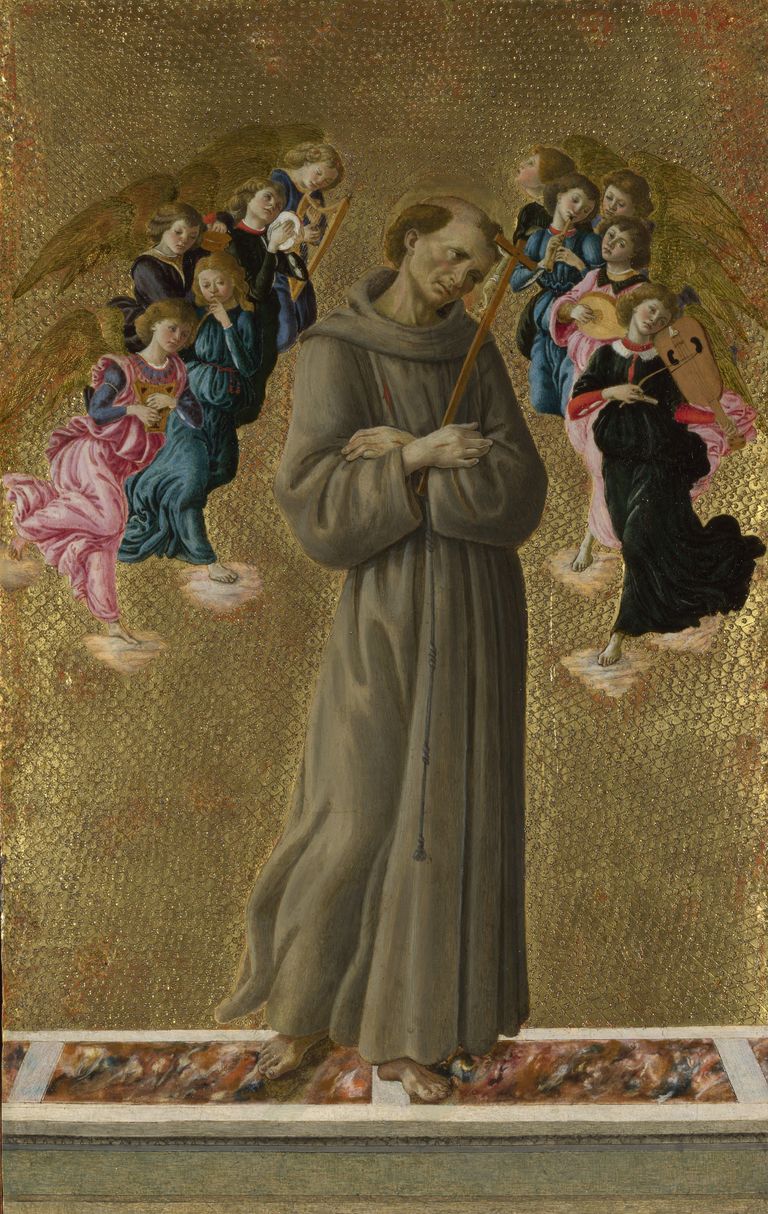
Death as fiddler — a recurring subject in the history of art — embodies the rapture of the third movement. While it initially remains open to whom the song and the danse macabre are addressed in the concerto’s reading of this theme, the images of the finale once again turn to Francis. The saint is enveloped in the sounds of an ‘angelic concerto’, experiencing his final rapture in the very moment of death.
On the individual movements:
First Movement – The Raptures of Francis
The movement — and with it the entire concerto — opens in an unusual way: with a solo cadenza for the violin. What sounds is the tonal signature of the name of Francis of Assisi in its Latin form, rendered into music — a sequence of pitches that becomes the most important and formative element of the entire work. This represents the awakening of a sense of mission, the dawning awareness of one’s own capacity to act, and the preparation for the spreading of his teaching — still turned inward, still suffused with a quiet, interior sensitivity.
In formal terms, this is a solo passacaglia: a cycle of variations, weaving artfully around the Franciscan pitch sequence in ever swifter and more virtuosic figurations.
At the apex of the cadenza, the orchestra enters — initially confined to the string section — and the mood remains contemplative. The orchestra too pursues a passacaglia, its harmonic sequence derived from the name of the saint. The lower string groups lead, playing in a hocketing style. The second violins introduce their own passacaglia, uncoupled from the lower strings; the first violins add a third, played pizzicato. The solo violin continues to unfold passages from its cadenza, resulting in a texture of remarkable density — one shaped entirely by the name of Francis.
Throughout the violin’s playing, the music-making of the angel is always reflected as well, spanning the concerto in its entirety.
Many painters — among them Gioacchino Assereto, Anthony van Dyck, and Francisco Ribalta — depict the saint alongside the angel-musician, showing him with his stigmata or at the threshold of death. According to the Fioretti, however, the angel played for Francis before the stigmatization, and so in Guido Reni’s painting Francis has not yet received the marks. This is also why Assereto’s painting of the same subject could in turn be assigned to the dying Francis of the fourth movement.
Then birdsong in the woodwinds and strings.
In a dance-like passage, a chorale-like melody makes itself heard, whose significance will unfold as the movement proceeds.
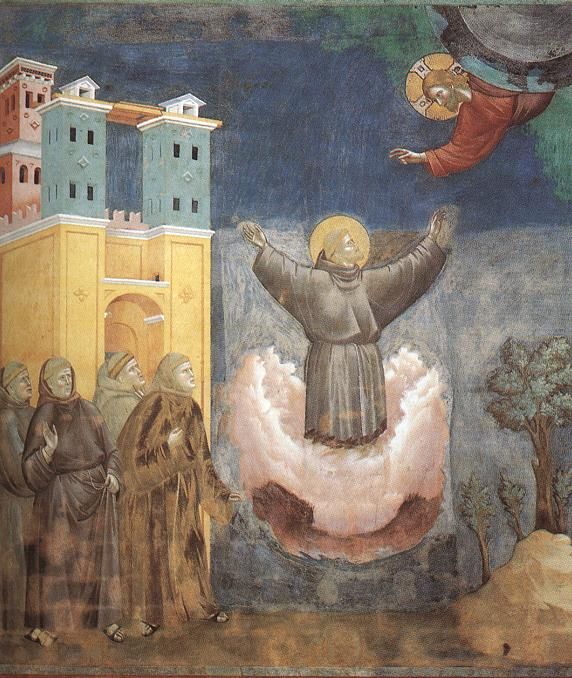
The music builds to a hymnic fanfare in the horns. Composed on purely musical — not programmatic — grounds, its multilayered meaning revealed itself only upon completion of the work. Musically, this is a so-called cross-motif: a tonal signature that, when one connects its first and last tones and its two middle tones, traces the shape of a cross. Here the cross-motif serves as signum for an epiphany over which Francis falls into ecstasy.
For one day, when he had withdrawn to pray and was wholly absorbed in God out of an excess of fervour, Jesus Christ appeared to him nailed to the cross. At this sight his soul was overcome, and the memory of Christ’s Passion was so powerfully impressed upon his heart that from that hour on, whenever he recalled the Passion of Christ, he could barely contain his tears and sighs outwardly — as he himself confided near the end of his life.
So it is written in the Legenda Maior (1260–1262), the life of Francis deemed authoritative, by the holy Bonaventure (1221–1274).
Suddenly — calling, chirping, whistling, and fluttering throughout the entire orchestra: a concert of birds, erupting just as it did when Francis, following his sermon, granted the birds leave to sing again (cf. Legenda Maior, chapter 8). (The Fioretti name ‘crows, ravens, and magpies, and many other birds that fly through the air’. These species represent the outcasts, the sick, and the poor to whom Francis’s preaching was addressed.) Giotto depicted this sermon to the birds — among countless other episodes from the life and work of Francis — as part of a fresco cycle in the Basilica of San Francesco in Assisi, erected in the saint’s honour from 1228 onward.
Now, in intimation, a descending harmonic sequence, which will acquire its fuller meaning beginning with the second movement.
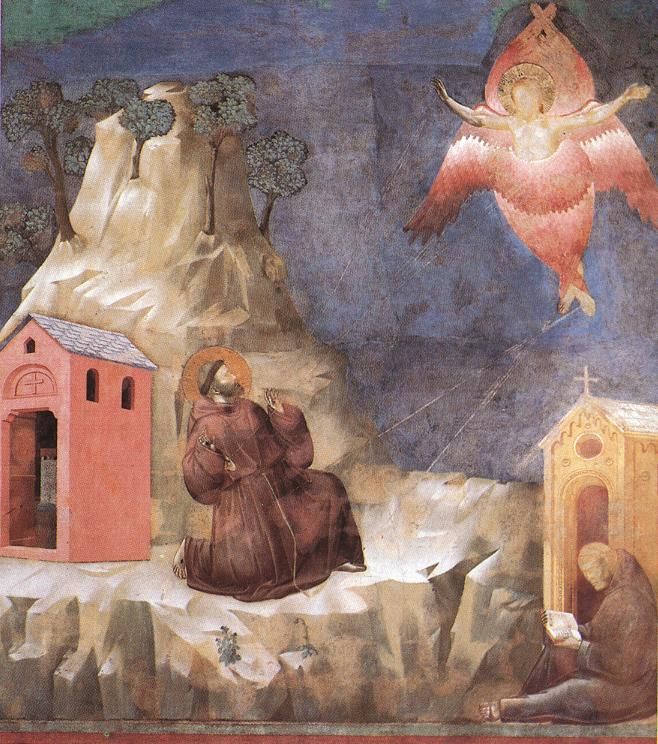
Harsh sounds in the percussion and low strings, and the screaming lines of the solo violin. The first stigmatization. Now the chorale sounds, likewise played by the solo violin, subsequently rising through numerous variations or strophes to the orchestra’s grandioso. Further stigmatizations follow — the second more powerful still, the others embedded in cantus firmus. Within the sounds of the stigmatization, the name Iesus Christus may be heard.
All of this is, then, yet another rapture of Francis. Musically, different stations of the saint’s life are interwoven: his stigmatization and the composition of the Canticle of the Sun. The musical architecture implies that Francis receives his Canticle as the stigmata are being impressed upon him — so that this song becomes the supreme expression and manifestation of that rapture. Embedded within the chorale, numerous motifs sound that will be elaborated upon in the course of the concerto. The horn fanfare rings out magnificently as well, again symbolizing the cross — for it is from a crucified seraph that Francis receives the stigmata — and evoking the rising of the sun, all the more apt in the context of the Canticle, and because legend holds that Francis received the stigmata gazing upon the rising sun, or upon the light breaking over the mountain peaks.
Cradled in the sounds of the harp, the ‘Francis’ theme sounds at last.
Second Movement – The Rapture of the Sleeping Christ Child
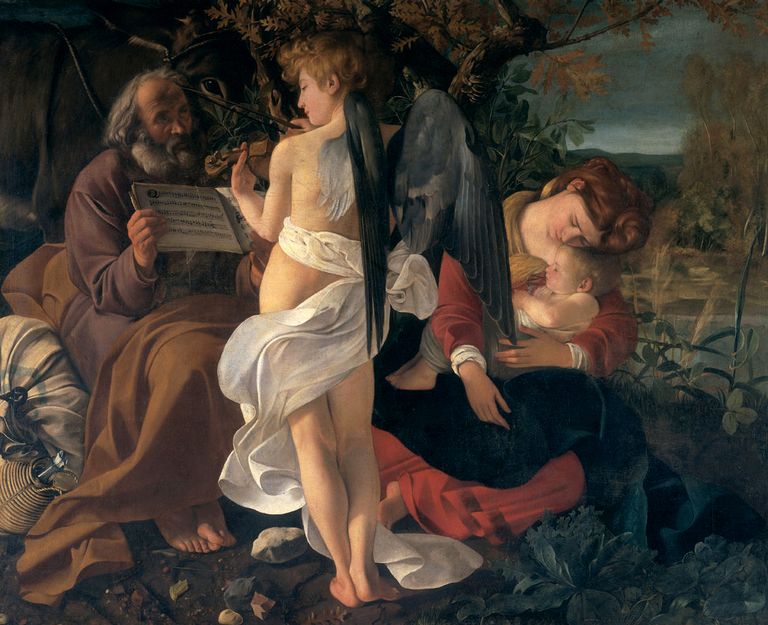
The movement opens with the descending, sequential harmonies heard earlier, beneath a chromatically falling melodic line — passed from the high to the low strings, tracing in sound the angel’s descent as Caravaggio depicts it: an angel playing a lullaby to the Christ Child in a scene of touching tenderness. (Caravaggio also painted Saint Francis, in a work of around 1595; Guido Reni in turn painted another interpretation of the Flight of the Holy Family into Egypt.)
Joseph holds the music book — it shows a motet by Noël Bauldeweyn — while the Mother of God cradles the sleeping child. Little suggests the family’s flight into Egypt: perhaps the flask in a woven basket, or the bridled donkey, which calls to mind rather the nocturnal idyll of the stable in Bethlehem, and anticipates Christ’s entry into Jerusalem. (The painting very likely also contains erotic undertones, as is characteristic of Caravaggio.)
Already in the first movement — as now becomes clear — this harmonic sequence symbolized the descent of an angel: that very seraph who, according to the Legend of the Three Companions, in the late summer of 1224, brought the wounds of Christ to Francis as he had withdrawn to Mount La Verna. (Some details of the historical circumstances appear in the description of the fourth movement.)
Over the sounds of two harps the angel traces his expansive melodic lines, hovering.
The calm is broken by the woodwinds, then by the horns, which — fading to pianissimo — lay a delicate harmonic foundation beneath the scene that follows.
Simple fourth-motifs recall the birdsong that came before, and the threads of the Francis thematic material.
A great climax unfolds from a turn-figure, flowing into a free da capo, then taking up the horn fanfare.
Third Movement – Rapture at the Fiddling of Death
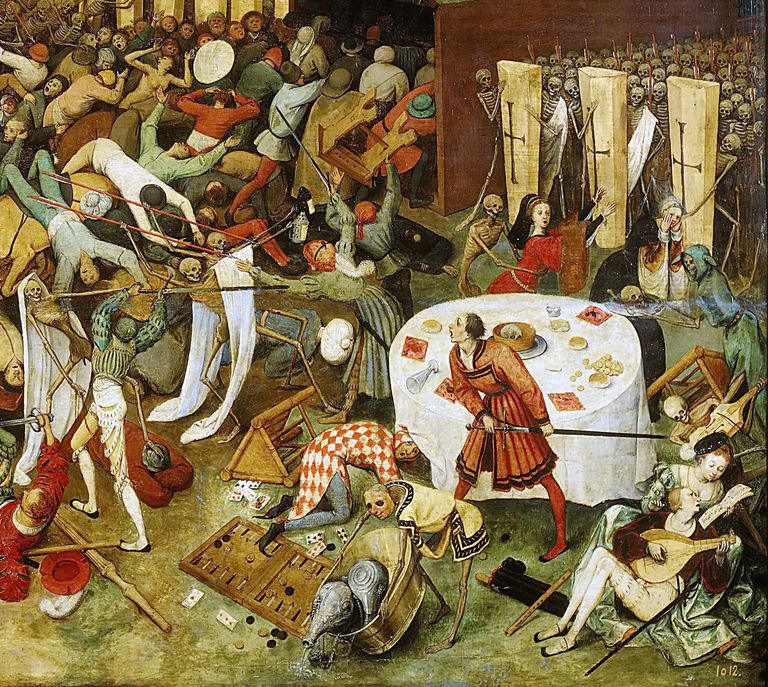
Vanitas symbols — the term derives from the opening words, ‘Vanitas vanitatum, et omnia vanitas,’ of the preface to Qohelet (cf. Eccles. 1:2) — are extraordinarily plentiful in the history of art, and among them Death as fiddler or musician is a motif frequently invoked: in the Middle Ages, instrumental music was considered to serve pleasure alone. Bruegel depicts worldly pleasures in the section of the painting shown — lovers making music, a game of backgammon and cards, a feast, a fool. Celebrated images of Death as musician include Arnold Böcklin’s Self-Portrait with Death Fiddling of 1872, Frans II Francken’s (1581–1642) Allegory of Death Fiddling, Alfred Rethel’s danse macabre drawings, and Holbein’s woodcuts. The fiddle or violin, moreover — laden with symbolic charge — is frequently depicted as having only one string, or a broken one; when single-stringed, it is usually strung only with the lowest string, the G-string. The celestial heights of the heavenly spheres are absent. (Incidentally, one of the strings of the violin in Caravaggio’s painting is also broken, hanging above the sheet of music — perhaps a reference to the death on the cross that awaits the child. A widely known example is the broken lute string in Hans Holbein the Younger’s The Ambassadors of 1533, one of the most famous of all vanitas images.)
Once again, it is a painting of a supernatural power playing the violin that inspired a movement of this violin concerto: visible in the detail of Pieter Bruegel’s painting, lower right, hovering above the lovers. In other details of the painting, the artist also shows Death playing kettledrums and a hurdy-gurdy.
After sounds wrung under high bow pressure from a brief, slow introduction, a wild dance erupts. First a pounding rhythm in all the strings, which finds its echo in the thematic material of the solo violin.
The bony quality of Death’s dancing is rendered in the percussion — not heavily scored — by the sound of five temple blocks: struck idiophones fashioned from wood or plastic.
The underlying harmonic progressions harbour a secret that the fourth movement alone will finally and unambiguously disclose.
The wild dance flows into a cadenza. A cantilena sounds from the solo violin on the low strings, harmonically accompanied by chords on the high strings. This is reminiscent of the low string of Death’s instruments. That the music sounds here all the softer may come as a surprise in the context of the danse macabre.
The dance rhythm returns. The orchestra enters in successive waves. Then the cantilena as a hymnic fanfare, with the danse macabre theme counterpointed by the woodwinds.
Ethereal sounds of the harps and the muted strings. Above them, the solo violin continues to dance. The strings play natural harmonic glissandi here — a sonority that evokes glass and its fragility.
A sudden acceleration in tempo, and a brief, percussively charged postlude.
Fourth Movement – Rapture in Death
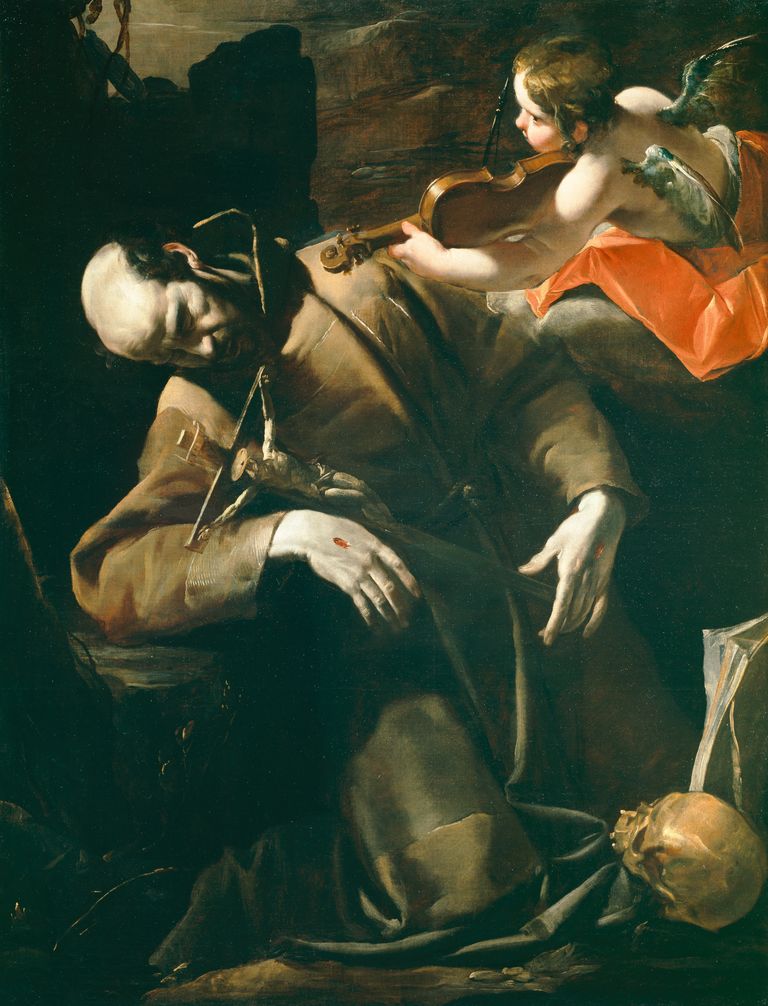
The finale, which once again turns to Francis, weaves everything that has come before into an often polyphonic fabric, and is comparable to the first movement in both scale and complexity.
It opens with a further strophe of the Canticle of the Sun, intoned by the brass. The solo violin counterpoints this with the music of Death’s fiddling, and the first clarinet adds a free, fleet-footed line. But how is this to be understood?
The great hymn is a praise of God and of nature as creation. The incipit of each strophe is the familiar ‘Laudato sie’. In the individual strophes, Francis praises all creation in a voice that is almost folk-like in tone — the hymn is written in an ancient dialect of Umbrian, and stands as the earliest surviving document of Italian literature — above all ‘Lord Brother Sun’ and ‘Sister Moon’.
Praises follow for the wind, the weather and the rain, Mother Earth and her fruits, flowers and herbs. The opening strophe and the closing strophe are addressed to ‘my Lord’. The strophe that closes the hymn may furthermore be read as a doxology.
In late 1224 or early 1225, confined to his sickbed, marked by the hardships of his journey to Egypt and by excessive fasting, and nearly blind, Francis dictated the hymn at San Damiano. Individual sources indicate that Francis composed the second-to-last strophe — the strophe of peace — somewhat later, and the strophe of death (‘Praised be You, my Lord, for our Sister, bodily Death’) immediately before his own death.
It is this circumstance that the concerto addresses. While the composition of the first nine strophes is — in the present concerto, ahistorically interpreted — interwoven with the stigmatization by the seraph, that six-winged angel, the composition of the death strophe is transposed to the finale of the concerto. This, then, is also why the (newly composed) cantus firmus of the Canticle is combined with the music of death from the preceding movement.
Tonal impressions of the first movement follow — the turn-figure of the second (already intimated in the opening movement), the fourth-motif that may evoke a musically stylized quail call, itself drawn from the music of the Canticle — further birdsong, all of it suspended above the enigmatic harmonies of the four horns, familiar from the second movement.
In a faster tempo, following a further turn-figure passage in the horns, the Francis theme of the solo violin returns at last.
The chorale swells through the heavy brass. This passage is enriched by the sequential harmonic progressions that have twice before been associated with a descending angel. Here an angel — as depicted in the painting — comes to the dying man, in order to lead him, once again through music, into rapture at the very hour of death. That this scene is drawn neither from the writings of Celano, nor from the Fioretti (anonymous), nor from Bonaventure’s Legenda Maior or other historical sources — and that it again represents an interweaving of distinct stations in the saint’s life — has already been noted.
Now the ‘angelic harmonies’ sound simultaneously in different string groups, evoking the descent of whole hosts of angels. Harmonically the upper string groups drift apart, meeting again at regular seams. Numerous further motifs of reminiscence sound in all instruments and in the solo violin.
A crescendo and a fortissimo outburst. The delicate cantabile theme of the solo violin (second movement) is here raised once more to the level of a festive hymn. The trumpets lead; the woodwinds counterpoint with the cantus firmus of the Canticle.
Ethereal sounds. Then a fresh outburst. The Chorea Machabaeorum — the danse macabre — in the trumpets alternates with the Canticle of the Sun in the horns. To this, the full concert of birds. Legend holds that larks — the beauty of the calandra lark’s song is proverbial in Italian — soared aloft at the moment of the saint’s death. Here his transfiguration is joined to the concert of all birds of every kind.
The cross-motif and the motif of the rising sun sound repeatedly — here more than ever the signature of the saint’s rapture before death. Light and sun, the stigmata and the cross itself, and the crucified seraph are now united in this single musical symbol. (The word seraph is rendered — according to the Hebrew of its first syllable — as ‘the Burning One’.)
The harmonies of the descending angels sound again, now in several voices at once. But here a secret reveals itself: the lower strings play a particular and characteristic harmonic sequence — none other than the one that, now in greatly augmented tempo, pervaded the entire danse macabre of the third movement: the melodic-harmonic signature of death itself.
And yet there is more: the ascending harmonies are the inversion of the angelic harmonies that here, as before, embody the descent of the angels. Not only are the ascending and descending harmonic sequences related to one another — in an almost antithetical sense — but the death-harmonies, striving upward, harbour within them the signature and secret of a resurrection: entirely in the spirit of the Canticle, which praises ‘Sister Death’ accordingly, and of the Easter mystery — ‘In death is life!’ (cf. John 12:24).
Then — with the greatest force — the Francis theme in the full brass, ethereal string sonorities, and an unexpected close to the concerto: a brief, gently repetitive cadenza for the solo violin alone — a counterbalance to the opening cadenza with which the work began.
Sandro Botticelli’s painting, finally, shows Francis amid a host of angel-musicians. Here, what the harmonic and melodic structures first intimated — and what the finale lays before us in full — is made manifest.